
Japan Insurance MonitorMarket ExplainerDistribution
Why Japan's Insurance Market Runs Through Agencies — and Whether That Is Changing
Ninety percent of Japan's non-life premium moves through agencies acting for the insurer, and the reasons are structural. A current reform tests whether that structure can still change.
Nine-tenths of Japan’s non-life insurance premium is placed through agencies. Under one percent goes through brokers — three decades after Japan made broking legal12. An international insurer reading those two numbers usually draws the wrong conclusion from each: that the agencies are something like independent advisers, and that the brokers’ absence is a gap waiting to be filled. Neither holds. The explanation is structural, and it starts with what the two words mean in Japanese law.
What “agent” and “broker” mean in Japan
The distinction is statutory, and stricter than the everyday English. An agency (損害保険代理店) is appointed by an insurer and acts for that insurer; the insurer answers for what it does. A broker (保険仲立人) is defined by exclusion — an intermediary that does not act for an insurer — and owes the customer who engages it a duty to act faithfully on that customer’s behalf. Nobody may be both: the Insurance Business Act refuses broker registration to insurers’ officers and to registered sales personnel. And until this June, a broker had to bill its entire fee to the insurer and none of it to the client it represented2.
Two sides of a legal line, then: an intermediary that acts for the insurer and is paid by it, and one that acts for the customer — and was, until recently, also paid by the insurer. At the end of FY2024 there were 140,138 agencies, 82.5% of them businesses selling insurance on the side, 76.4% tied to a single insurer, and more than half of them car dealers and repair shops12. There were 64 registered brokers10.
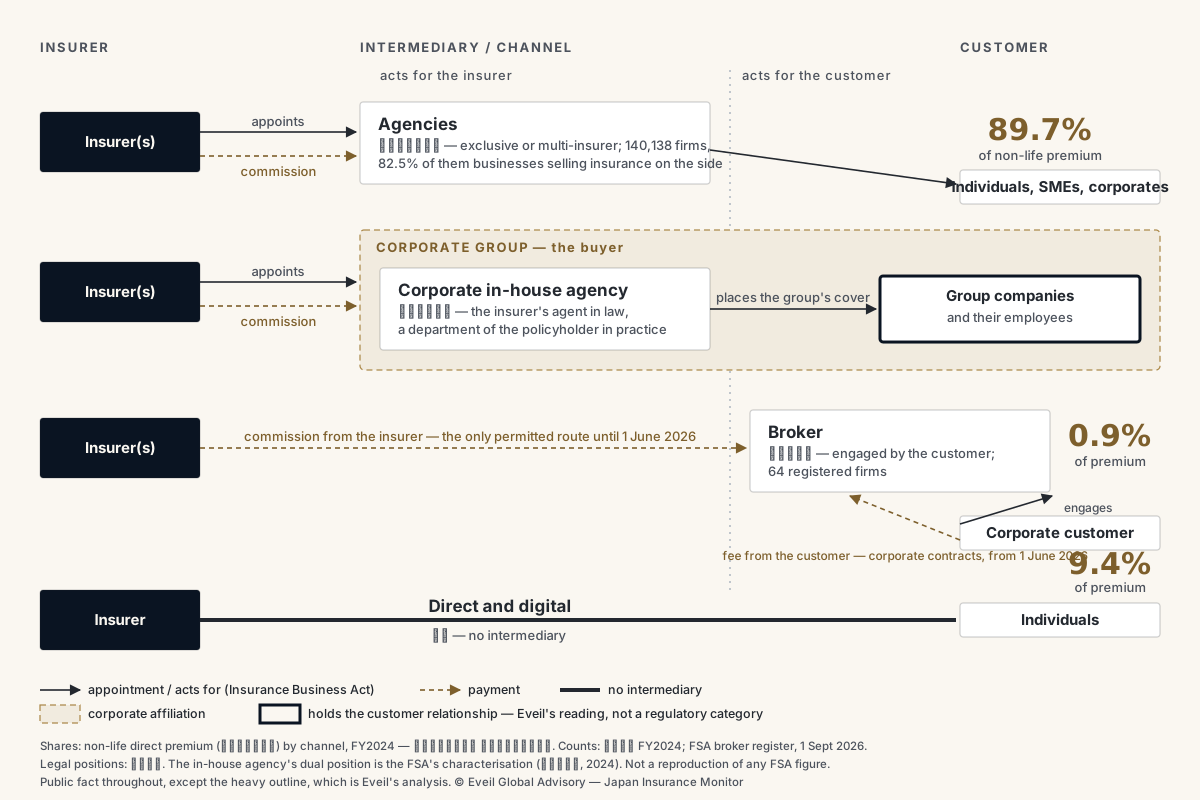
Japan Insurance Distribution Landscape. Shares are non-life direct premium, FY2024, from the General Insurance Association of Japan; the legal positions follow the Insurance Business Act; the position of the corporate in-house agency is the FSA’s own characterisation. The heavy outline marking who holds the customer relationship is Eveil’s reading, not a regulatory category.
Why the structure evolved this way
For most of the post-war period, Japanese non-life insurers were obliged to use the rates set by their rating organisations, so — as one review of the first twenty years of liberalisation puts it — price competition did not arise; the mandatory use of those rates ended only in 199814. The brokers’ association describes the same market from the buyer’s side: identical cover, identical premiums, and insurers chosen by corporate affiliation and long acquaintance13. Eveil’s reading: with price fixed, distribution was the competition, and the relationship that held the account was the unit of competition.
Large companies drew a natural conclusion. If the premium could not be lowered, a group could own the entity that received the commission. The brokers’ association records that groups set up agencies to obtain the commission income as, in effect, a discount on premium13; a 1998 trade survey cited in the same academic review lists the expectation of a partial premium rebate through commission among the reasons companies ran their own agencies14. The FSA’s panel notes that such agencies have existed since before the war1. When the broker regime arrived in 1996, then, the function a broker performs — sitting on the buyer’s side of the placement — was already being performed inside the largest buyers, and the money was staying there. That, in the review’s words, is the background to why broking never spread14. Liberalisation freed the price. It did not dismantle the structure that had grown up around a fixed one.
Where the in-house agency sits
The corporate in-house agency (企業内代理店) is an agency with close capital or personnel ties to a company outside insurance, handling that group’s fire and liability cover and its employees’ policies3. In law it is the insurer’s agent. In the FSA’s own description it holds two positions at once — the insurer’s agent and a department of the policyholder company4. Nobody counts them as a regulated population; each insurer classifies its own, and the FSA notes that the definitions differ2.
A corporate-owned intermediary is not uniquely Japanese; Germany, for one, recognises company-affiliated intermediaries as brokers acting for the group and polices the same risk of commission becoming a disguised rebate11. What differs in Japan is the legal position — the in-house agency remains the insurer’s agent — together with its scale and what the commission does.
Why that position became a competition concern
Two earlier Monitor pieces examined conduct and incentive inside this structure: Japan Tightens Insurance Distribution Governance traced the governance duties now placed directly on large agencies, and When the Insurance Intermediary Belongs to the Buyer asked what an in-house agency’s commission is actually paying for. The question here is one level up: whether the structure of distribution itself shapes how insurers and channels compete for a customer’s business.
When the FSA examined the premium-adjustment cases of 2023, it found conduct that may have breached the Antimonopoly Act had been widespread among the large insurers, and it looked for the structure behind it1. Large corporate risks are placed through co-insurance: the customer designates a lead insurer and the others, proposes the shares, and the panel underwrites jointly. The practice had been for the other insurers to match the lead insurer’s premium, and shares were influenced by non-insurance factors — the insurers’ shareholdings in the customer, and the benefits and services they provided to it1. The Fair Trade Commission, ordering surcharges of about ¥2.07 billion against four insurers, described co-insurance as a structure in which coordinated behaviour comes easily9.
The in-house agency mattered because it sat in the middle of that panel. The panel report lists its structurally unclear position among the background factors, and states that the position may have raised the risk of antitrust breaches — a possibility, not a finding1. The secretariat’s account of the mechanism is concrete: information moved between insurers through the agency, and insurer sales staff sometimes treated the agency’s requests as the customer’s wishes when it was not clear whose wishes they were4. The report adds that an agency with little practical capability can survive on its group’s business alone, which may hinder entry by brokers and other agencies — and that even if capability improves and independence advances, the distortion caused by the unclear position remains1.
None of this says the architecture caused the cartel. Insurers fixed prices, and were penalised for it. What the regulator’s own analysis says is that the architecture made the conduct easier to sustain and harder to see — which is why the remedies that followed are architectural rather than only behavioural.
What has already changed, and what is proposed
Three dates carry the reform, and they should not be merged. The Insurance Business Act was amended in 2025. The ordinances and supervisory guidelines implementing it took effect on 1 June 20266. And on 11 September 2026 the FSA opened public comment on a further amendment to the guidelines, which closes on 13 October and has no application date yet7.
Since June, a broker may charge its fee to the corporate customer rather than only to the insurer, the minimum guarantee deposit has been halved to ¥10 million8, and brokers may work alongside agencies subject to safeguards against the customer mistaking which is which — the measures the working group had recommended to promote a channel it found little known and little used2. For the first time, the Japanese broker can be paid by the party it represents.
The September proposal reaches the other two pieces, and it remains a proposal. It does not abolish the in-house agency. An agency that can show genuine capability, independence from its parent and a commission built from its reported costs may continue, with capability judged by the sponsoring insurer, while the framework limiting how much of an agency’s business may come from its own group is tightened in stages, the last from 20327. Contracts on which a broker charges only the customer would sit outside that framework. Co-insurance would be governed more tightly too: controls on the exchange of competition-related information, confirmation of the policyholder’s actual intent by corporate-linked agencies, and a check that co-insurance is genuinely necessary before an insurer proposes it7.
Read together, the package addresses the position of the in-house agency, the economics of the broker, and the practice of co-insurance. It does not require an in-house agency to tell the policyholder whose interest it represents; the safeguards face the insurer.
Does reforming the in-house agency model change competition?
This section is Eveil’s interpretation, not a position stated by the regulator.
It changes the terms on which channels compete. Whether it changes competition depends on the buyer. Under the proposal, a capable in-house agency continues, on a commission reconciled to its costs; the relationship stays where it was, and the buyer’s own staff still decide which insurers sit on the panel. The reform asks that agency to become more clearly one thing, and asks nothing of how the company buys.
The broker’s new economics face the same constraint from the other side. The panel’s chair put the obstacle plainly: if a customer pays the broker, the premium bought through the broker has to be correspondingly lower, or nobody will buy through one5. That is a question about how insurers price a broker-placed risk against an agency-placed one, and about whether a corporate buyer sees enough value in customer-side advice to pay for it — neither of which a supervisory guideline settles. Thirty years of legal broking produced 64 firms and 0.9% of premium. Four months of customer-paid fees have produced no data at all.
So the honest formulation is narrower than “the market is opening”. Japan is changing the rules around the intermediary; whether that changes competition depends on something harder — whether corporate buyers begin to exercise meaningful choice over who represents them and how they procure, and whether genuinely alternative models can compete for that business on the new terms. The measure is not which channel wins. It is whether the buyer is choosing.
What would show that competition has changed
The evidence does not exist yet, and the article should not pretend otherwise. It can say what the evidence would look like, so that it can be recognised when it arrives.
What to validate next Outcomes, not availability — and in that order. The strongest evidence is in procurement: buyers choosing insurer panels on commercial terms rather than relationship, and co-insurance pricing and shares set through genuine competition rather than following the lead insurer. Next is actual use — customer-paid broker mandates taken up rather than merely permitted, and large programmes genuinely placed through an alternative channel. Only after that would it show in channel shares, starting with brokers’ 0.9%; the number of registered brokers, 64 today, is weaker still — an availability signal, not a competition one. In-house agencies exiting rather than qualifying once the tightened framework applies from 2030 is a further structural outcome to watch. None of this has been observed as of September 2026.
Until some of that is observed, the accurate description is that Japan has rewritten the position of its intermediaries and left its buyers’ habits untouched. Broking has been legal in Japan for three decades; what 2026 changed is its economics and its room to operate alongside agency distribution. That is the map an international insurer, broker or platform should plan against. What the reform has not yet shown is whether corporate buyers will choose differently.
Reviewing how Japan’s distribution structure bears on your own route to market? Eveil Intelligence is structured work on one organisation’s question.
References
Primary and authoritative sources
- 「損害保険業の構造的課題と競争のあり方に関する有識者会議」報告書
- 金融審議会「損害保険業等に関する制度等ワーキング・グループ」報告書
- 損害保険業等に関する制度等ワーキング・グループ 事務局説明資料(企業内代理店関係)
- 「損害保険業の構造的課題と競争のあり方に関する有識者会議」第3回 事務局説明資料
- 「損害保険業の構造的課題と競争のあり方に関する有識者会議」第4回 議事録
- 令和7年保険業法改正に係る「保険会社向けの総合的な監督指針」等の一部改正(案)に対するパブリックコメントの結果等について
- 「保険会社向けの総合的な監督指針」(令和8年9月パブリックコメント開始分)の概要
- 保険業法施行令の一部を改正する政令(令和7年政令第429号)— 新旧対照表
- 損害保険会社らに対する排除措置命令及び課徴金納付命令等について
- 保険仲立人登録一覧
- Versicherungsaufsichtsgesetz (VAG) §48b — Sondervergütungs- und Provisionsabgabeverbot
- 2024年度 損害保険代理店統計
- 損害保険業等に関する制度等ワーキング・グループ 日本保険仲立人協会 説明資料